Banana Leaf Grand

🎉We are open for Dining, Takeout, and Group Tour Catering! Now available on Uber Eats, DoorDash & Grubhub Book Now

Filter Coffee 101: Why South Indian Coffee Is Different

If you’ve ever finished a South Indian meal and been handed a small steel tumbler of frothy, milky coffee instead of a regular cup, you’ve had your first introduction to filter coffee — and if you’ve had it, you probably understand why it has such a devoted following. This guide covers what filter coffee actually is, how it’s brewed, why it tastes so different from drip or espresso-based coffee, and what to expect the first time you order one.

What Is Filter Coffee?

Filter coffee — sometimes called Madras filter coffee or, in Tamil, “kaapi” — is a traditional South Indian coffee preparation made using a metal filtration device (not a paper filter) to slowly brew a strong, concentrated coffee decoction, which is then mixed with hot milk and sugar to taste.

It originated in South India, particularly Tamil Nadu and Karnataka, in the 17th–18th century and remains a daily ritual in South Indian households — often the first thing brewed in the morning and the last thing offered to guests before they leave.
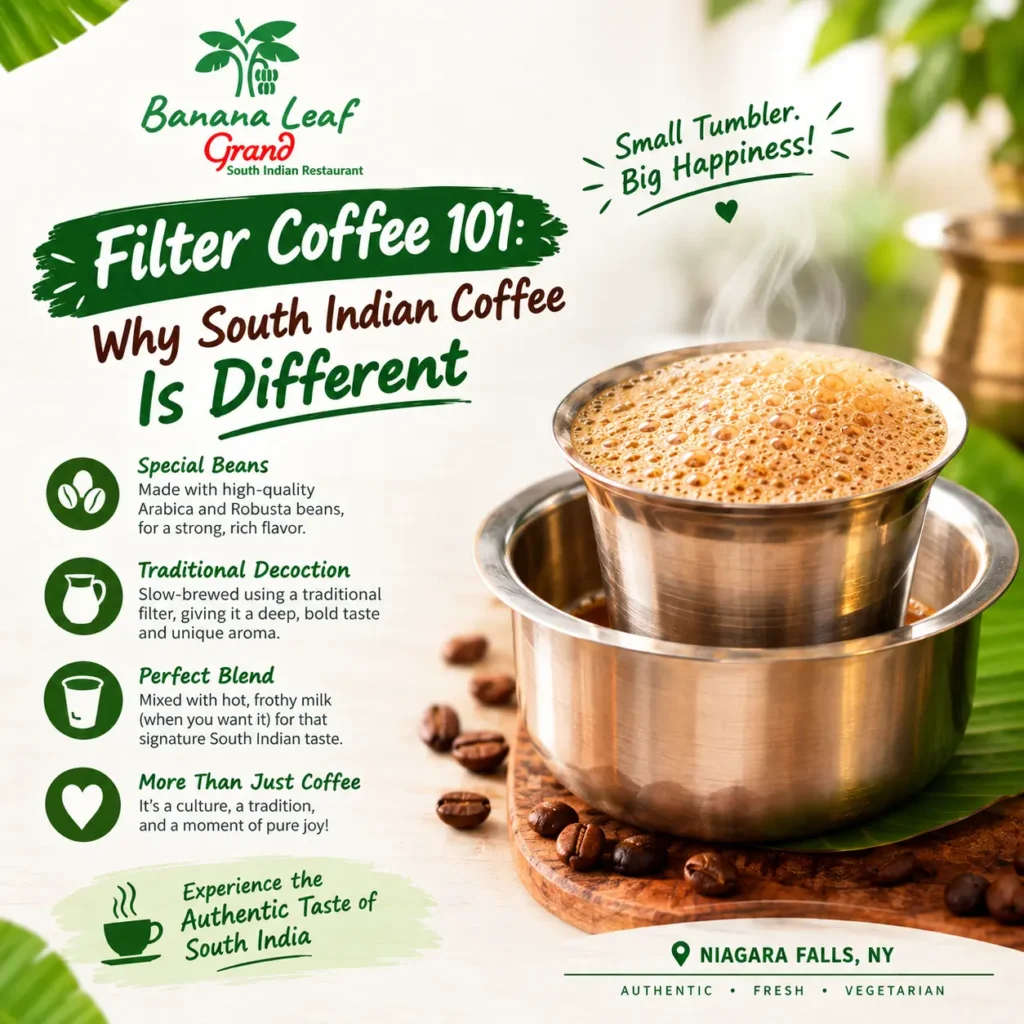
Filter Coffee 101 Why South Indian Coffee Is Different

How Filter Coffee Is Made

The process is simple in concept but specific in execution, and the equipment matters as much as the coffee itself.

The device: A traditional South Indian coffee filter is a two-chambered stainless steel or brass vessel. The upper chamber has a perforated base and holds the ground coffee; the lower chamber collects the brewed decoction as it slowly drips through.

The coffee: Ground coffee (often blended with a small percentage of chicory, which adds body and a slightly earthy, less acidic edge) is packed into the upper chamber and pressed down gently with a disc-shaped plunger.

The brew: Hot water is poured over the packed coffee grounds and left to slowly filter down into the lower chamber — a process that typically takes 15 to 20 minutes, much longer than drip coffee or espresso, resulting in a thick, strong decoction.

The mix: The resulting decoction is combined with hot, frothed milk (typically in a smaller proportion of coffee to milk than a Western latte) and sugar, then “mixed” by pouring rapidly back and forth between two vessels — usually a steel tumbler and a wider bowl called a davara — from a height. This aerates the coffee, creating the characteristic froth on top and cooling it slightly to a more immediately drinkable temperature.

Why Filter Coffee Tastes Different From Regular Coffee

A few specific factors combine to give filter coffee its distinct flavor, and understanding them helps explain why it doesn’t taste like drip coffee, espresso, or instant coffee.

Slow filtration, not pressure. Espresso uses pressure to force hot water through finely-ground coffee in seconds. Filter coffee uses gravity alone over 15–20 minutes, extracting a different, less bitter, more rounded flavor profile.

Chicory content. Many South Indian filter coffee blends include 10–30% chicory root, a practice that dates back to colonial-era coffee shortages but has since become a deliberate flavor choice. Chicory adds a woody, slightly bitter-sweet depth and reduces the acidity of the final cup.

The milk-to-coffee ratio and frothing method. Unlike a latte, where steamed milk is the dominant component, filter coffee typically uses a stronger ratio of decoction to milk, and the traditional pour-mixing technique (rather than a steam wand) creates a distinct light froth without diluting the coffee’s strength.

Metal, not paper, filtration. Paper filters (used in drip coffee) absorb some of the coffee’s natural oils. The metal filter used for South Indian coffee allows those oils through, contributing to a fuller-bodied mouthfeel.

filter coffee

What Filter Coffee Is Served In — and Why It Matters

Part of the filter coffee experience is the vessel itself: a small steel tumbler set inside a wider steel bowl (the davara). The tumbler holds the coffee; the davara serves two practical purposes — it catches any overflow during the pouring/mixing process, and it can be used to cool the coffee slightly by pouring it back and forth, or as a saucer to sip from directly, a traditional practice in some households.

If you’re served filter coffee this way rather than in a standard mug, that’s not a stylistic choice — it’s the traditional serving method, and part of what makes the coffee taste and feel the way it does.

Filter Coffee vs. Regular Coffee: Quick Comparison

Feature Filter Coffee Drip Coffee Espresso
Brewing method
Gravity, metal filter, 15–20 min
Gravity, paper filter, 3–5 min
Pressure, 20–30 sec
Common additive
Chicory (10–30%)
None
None
Milk ratio
High milk-to-coffee ratio
Usually black or light milk
Low (espresso) to high (latte)
Serving vessel
Steel tumbler + davara
Mug
Small cup or glass
Flavor profile
Strong, slightly sweet, low acidity
Milder, more acidic
Very strong, concentrated

How to Order and Drink Filter Coffee for the First Time

If you’re new to filter coffee, here’s what to expect and how to approach it:

  1. Expect it strong and sweet. Filter coffee is typically served pre-sweetened, not customizable at the table the way a coffee shop order is — if you prefer less sugar, ask when ordering rather than after it arrives.
  2. It’s smaller than a typical American coffee. A traditional serving is closer to a large espresso shot with milk than a 12-ounce mug — don’t expect a large cup.
  3. Drink it warm, not hot. The pouring/mixing process cools it slightly by design; it’s meant to be drunk relatively quickly rather than nursed over an hour.
  4. It’s traditionally an after-meal drink, not a wake-up-and-go beverage the way Western coffee culture treats it, though many South Indian households do also drink it first thing in the morning.

Frequently Asked Questions

South Indian filter coffee is made from a strong coffee decoction (brewed slowly through a metal filter, often blended with chicory), mixed with hot milk and sugar.

It's named for the traditional metal filtration device used to slowly brew the coffee decoction, as opposed to methods using paper filters, pressure (espresso), or instant coffee powder.

Many traditional South Indian filter coffee blends include 10–30% chicory root, which adds body and reduces bitterness, though pure coffee versions without chicory also exist.

Filter coffee's decoction is quite concentrated, similar in strength to espresso, but it's typically diluted with a significant amount of milk before serving, resulting in a final drink that's strong but not as intensely bitter as a straight espresso shot.

A davara is the wide steel bowl that a filter coffee tumbler sits inside; it's used to catch overflow during the traditional pouring/mixing technique and is sometimes used to cool and sip the coffee directly.

Yes, though it's less traditional — most South Indian restaurants can prepare it without sugar or with the decoction only (sometimes called "black coffee") if you ask when ordering.

Banana Leaf Grand is located at 427 3rd Street, Niagara Falls, NY 14301 — a 5-minute drive from Niagara Falls State Park, near the Rainbow Bridge border crossing. We are the nearest South Indian restaurant to Niagara Falls, serving Tamil cuisine for tourists, local families, and South Indian food lovers across Western New York and Southern Ontario, Canada. From Buffalo, NY: approximately 25 minutes via I-190 N. Open daily 12:00 PM – 10:00 PM. Call (716) 236-7006.