

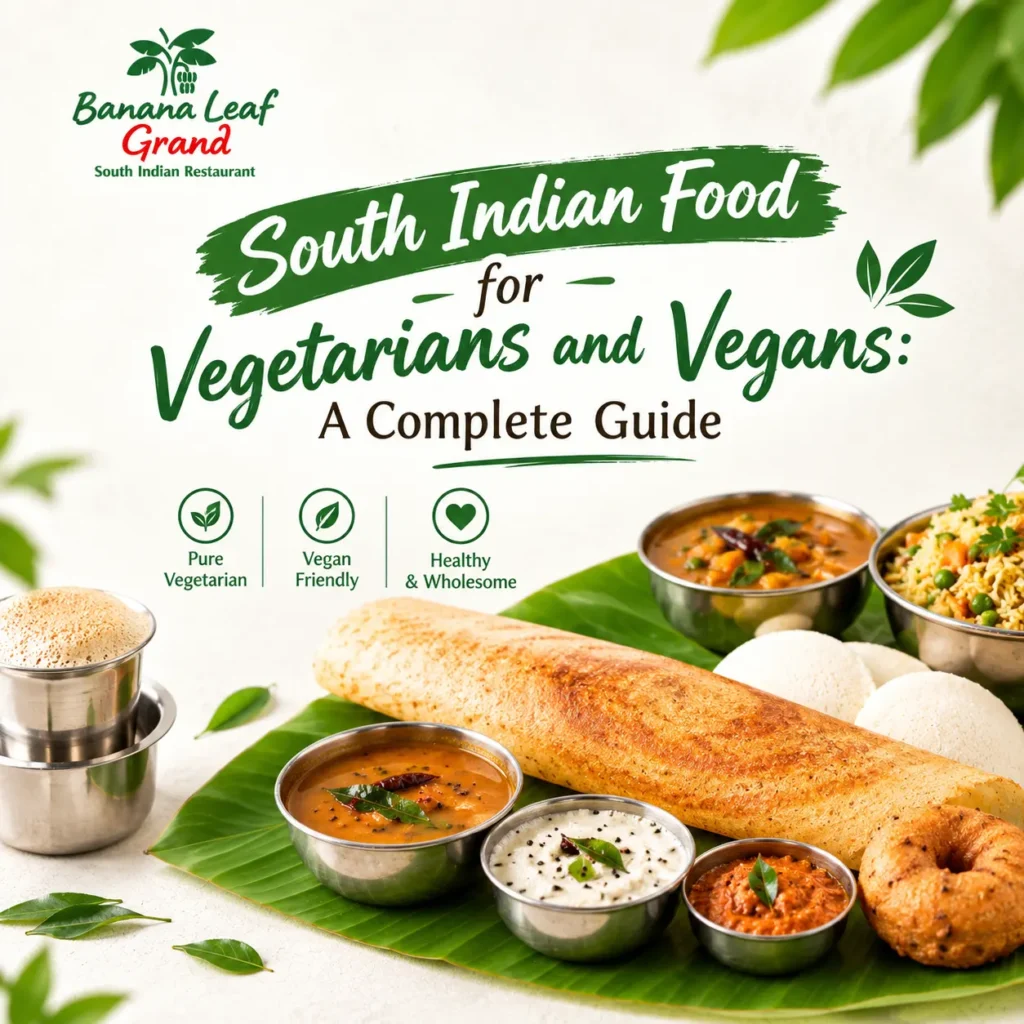
Of all the world’s major cuisines, South Indian food is one of the most naturally suited to vegetarian and vegan eating — not as an accommodation or a modified version of a meat-centric menu, but as a fully developed culinary tradition built around rice, lentils, vegetables, and coconut from the ground up. This guide covers exactly why that’s the case, which dishes are naturally vegetarian or vegan, what to watch for, and what to order on your first visit.
A significant portion of Tamil Nadu’s population follows a vegetarian diet by religious or cultural tradition, and South Indian restaurant menus — even ones that also serve meat — typically dedicate a large, fully developed section to vegetarian dishes rather than treating them as an afterthought or a single “veggie option” on an otherwise meat-focused menu.
This matters practically: at many North Indian or generalist “Indian restaurants,” the vegetarian section might be five dishes deep. At a proper South Indian restaurant, the vegetarian and vegan menu can be the majority of the offerings, with the same level of variety, technique, and regional specificity as the non-vegetarian dishes.
This distinction matters because South Indian cuisine, unlike many others, has a large number of dishes that are naturally vegan without any modification — not “vegan versions” of a dairy-based original.
Most “Indian restaurant near me” searches in Niagara Falls turn up North Indian buffets, simply because that style is more common across the U.S. If you want the South Indian / Tamil Nadu style specifically — dosa, idly, Chettinad curries — you’ll want to search more precisely, or head straight to a restaurant that specializes in it.

Because ghee is used so pervasively as a finishing touch — even in dishes that are otherwise plant-based — a few quick questions make a real difference for strict vegans:
Most South Indian kitchens are well-practiced at accommodating this, given how common strict vegetarianism already is within the tradition itself.
“Vegetarian Indian food is limited to a few dishes.” This is generally true of North Indian menus adapted for a broader audience, but not of South Indian menus, where vegetarian dishes are often the majority of the menu, not a side accommodation.
“Vegan means bland.” South Indian vegan cooking relies on tamarind, fresh chilies, curry leaves, mustard seed tempering, and coconut for flavor — it’s built to be flavorful without dairy, not flavored around a dairy-shaped hole.
“Gluten-free and vegan are the same thing here.” Not necessarily — most naturally vegan South Indian dishes (dosa, idly, sambar) are also gluten-free, but always confirm for dishes made with wheat-based ingredients like certain snacks or desserts.
Much of South Indian cuisine is vegetarian by tradition, and most South Indian restaurants offer an extensive vegetarian menu that's as developed and varied as the non-vegetarian offerings, rather than a limited side section.
Traditional dosa batter (rice and lentils) is naturally vegan. Fillings and preparation methods vary — plain and masala dosa are typically vegan, while cheese, paneer, or ghee-heavy versions are vegetarian rather than vegan unless made without those ingredients.
Dosa, idly, sambar, rasam, vada, and most coconut chutneys and vegetable curries cooked in oil rather than ghee are naturally vegan.
Many staple South Indian dishes — dosa, idly, sambar, rasam — are naturally gluten-free since they're based on rice and lentils rather than wheat, though it's worth confirming for specific dishes and any fried items that may use wheat-based batters.
Watch for ghee (used as a finishing touch on many otherwise plant-based dishes), curd rice, and milk-based desserts like payasam — otherwise, most of the menu is safely vegan or easily made so.
Generally yes — because strict vegetarianism is already deeply embedded in South Indian culinary tradition, kitchens are typically well-equipped to prepare dishes without ghee or dairy on request.
Banana Leaf Grand is located at 427 3rd Street, Niagara Falls, NY 14301 — a 5-minute drive from Niagara Falls State Park, near the Rainbow Bridge border crossing. We are the nearest South Indian restaurant to Niagara Falls, serving Tamil cuisine for tourists, local families, and South Indian food lovers across Western New York and Southern Ontario, Canada. From Buffalo, NY: approximately 25 minutes via I-190 N. Open daily 12:00 PM – 10:00 PM. Call (716) 236-7006.