

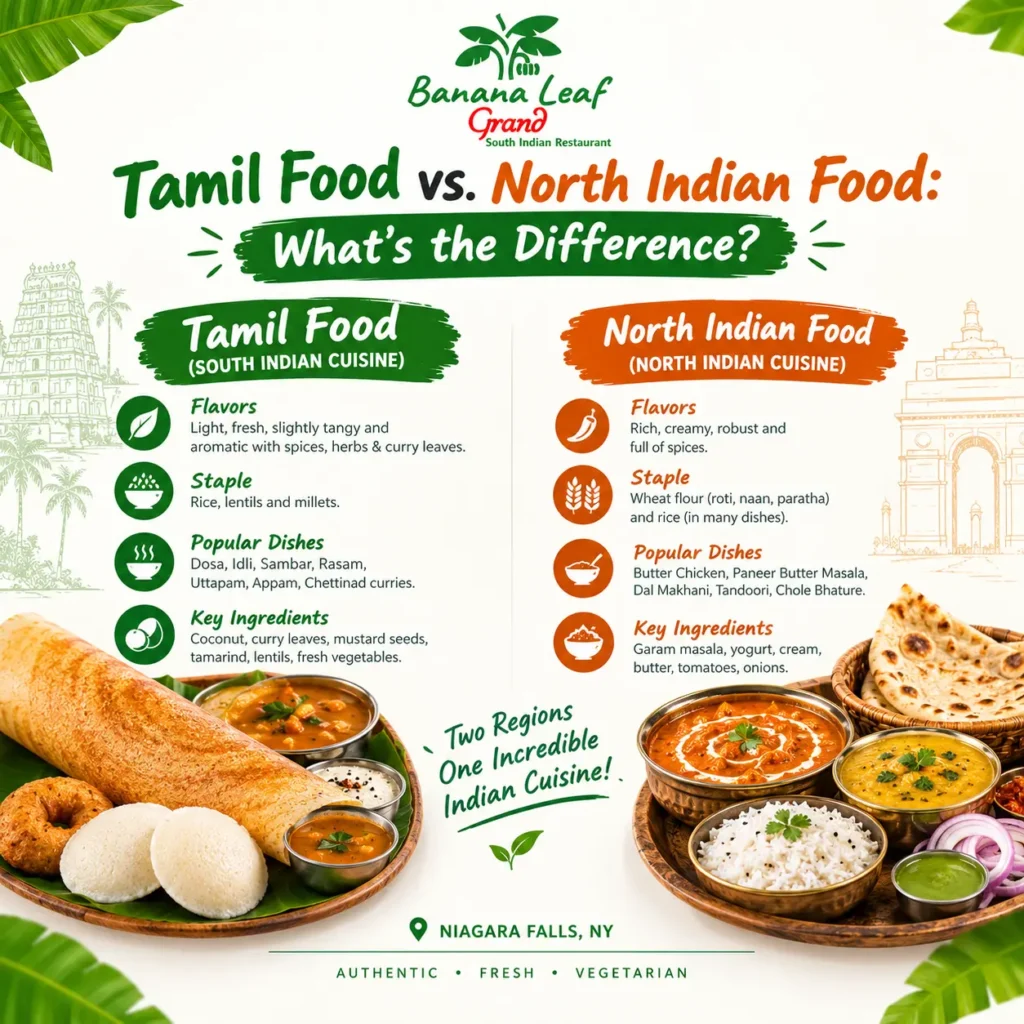
Walk into most “Indian restaurants” in the United States and you’ll find a fairly consistent menu: butter chicken, chicken tikka masala, naan, samosas, tandoori chicken. This is North Indian food, and it’s become so dominant internationally that many people assume it is Indian food, full stop. But India has dozens of distinct regional cuisines, and Tamil cuisine — from the southern state of Tamil Nadu — is about as different from North Indian food as Spanish food is from Swedish food. Same country, radically different culinary tradition.
This guide breaks down exactly where Tamil and North Indian cuisine diverge: staple ingredients, cooking techniques, spice profiles, meal structure, and signature dishes — so you know what to expect and what to order, whichever direction you’re curious about.
The single biggest structural difference between Tamil and North Indian food comes down to climate and agriculture. Tamil Nadu, in the tropical south, grows rice as its dominant grain. North India’s cooler, drier climate favors wheat. That single agricultural fact shapes almost everything else about how the two cuisines are built.
Tamil cuisine is rice-based. Steamed rice, rice batter (fermented for dosa and idly), rice flour, and rice-based porridges (like the popular breakfast dish pongal) form the backbone of most meals. Bread, where it appears at all, is a minor part of the meal.
North Indian cuisine is wheat-based. Naan, roti, paratha, and puri are central to how food is eaten — many North Indian curries are specifically designed to be scooped up with bread rather than eaten with rice, though rice dishes like biryani and pulao do exist.
This is the second major fork in the road, and it explains a lot about why the two cuisines taste so different.
North Indian food is dairy-heavy. Ghee, cream, yogurt, and paneer (a fresh cheese) appear throughout the cuisine — butter chicken and paneer tikka masala are built around cream and butter as core ingredients, not garnishes.
Tamil food uses dairy more sparingly and differently. Coconut (milk, grated flesh, and oil) takes the place dairy occupies in North Indian cooking, used in chutneys, curries, and desserts. Where dairy does appear in Tamil cuisine — like ghee on a dosa, or curd (yogurt) rice as a meal-ending dish — it tends to be a finishing touch rather than a base ingredient for a sauce.
Both cuisines use chili, but the sources and layering of heat differ meaningfully.
North Indian heat typically comes from dried red chili powder, garam masala (a warming spice blend of cinnamon, cardamom, cloves, and cumin), and is often mellowed by cream or yogurt in the final dish — resulting in rich, warming, rounded heat.
Tamil heat tends to come from fresh green chilies, black pepper, and mustard seeds tempered in hot oil (a technique called tadka or tempering), giving many Tamil dishes a sharper, more immediate heat along with a distinctive tang from tamarind, which is used far more heavily in Tamil cooking than in North Indian cuisine.
A traditional North Indian meal (thali) is typically served on a large plate with individual bowls for each curry, dal, rice, and bread, meant to be combined bite by bite according to preference.
A traditional Tamil meal is often served on a banana leaf — the literal origin of “banana leaf” restaurants — with rice at the center and curries, sambar, rasam, and chutneys arranged around the edges, traditionally eaten with the fingers of the right hand, mixing rice with each dish in sequence rather than eating them separately.
| Category | North Indian | Tamil / South Indian |
|---|---|---|
|
Bread/staple |
Naan, roti, paratha |
Dosa, idly, rice |
|
Curry |
Butter chicken, paneer tikka masala |
Chettinad chicken, kolambu |
|
Soup/stew |
Dal (lentil stew) |
Sambar, rasam |
|
Snack |
Samosa, pakora |
Vada, bonda |
|
Rice dish |
Pulao, biryani (Lucknowi/Hyderabadi style) |
Curd rice, lemon rice, biryani (Ambur/Dindigul style) |
|
Drink |
Chai (spiced milk tea) |
Filter coffee |
|
Cooking fat |
Ghee, butter |
Coconut oil, gingelly (sesame) oil |
Note that biryani exists in both traditions, but the styles differ significantly — North Indian biryani (Lucknowi, Hyderabadi) tends to be more subtly spiced and layered with saffron, while Tamil Nadu’s regional biryanis (Ambur, Dindigul) use a distinct short-grain seeraga samba rice and a sharper, more direct spice profile.
If you search “Indian restaurant near me” without knowing this distinction, you’ll likely end up at a North Indian restaurant by default, simply because it’s more common outside India. That’s fine if that’s what you want — but if you’re specifically craving dosa, idly, filter coffee, or the tangy, tamarind-forward flavors of Tamil cuisine, a North Indian restaurant genuinely won’t have most of these dishes on the menu at all. They’re not variations of the same dishes; they’re a different culinary tradition.
Conversely, if you walk into a Tamil restaurant expecting butter chicken and naan, you may be surprised to find neither on the menu — a genuine South Indian restaurant is built around an entirely different set of staples, and that’s a feature, not an oversight.

If you’ve only ever had North Indian food, Tamil cuisine is worth exploring specifically because it offers a genuinely different experience rather than a variation on something familiar. A reasonable entry point:
The main difference is the staple grain and base ingredients — Tamil food is rice-based and uses coconut and tamarind heavily, while North Indian food is wheat-based (naan, roti) and relies more on dairy (cream, ghee, paneer) and garam masala spice blends.
Tamil food is one of several South Indian cuisines, specific to Tamil Nadu. South India also includes Kerala, Karnataka, and Andhra Pradesh cuisines, which share some similarities with Tamil food (rice-based, coconut-forward) but have their own distinct dishes and flavors.
Not necessarily hotter overall, but differently spiced — Tamil food's heat tends to come from fresh chilies, black pepper, and tempered mustard seeds, while North Indian heat often comes from chili powder blended into rich, cream-based sauces.
Serving on a banana leaf is a traditional South Indian practice believed to add subtle flavor to the food, keep it warm, and offer a naturally biodegradable, hygienic surface — it's also the origin of the term "banana leaf restaurant" used for many Tamil restaurants abroad.
Yes — Tamil Nadu has its own distinct biryani traditions, notably Ambur and Dindigul biryani, which use short-grain seeraga samba rice and a sharper spice profile compared to North Indian biryani styles like Hyderabadi or Lucknowi.
Tamil food is often lighter due to lower dairy and cream content and a greater reliance on steamed and fermented preparations (like dosa and idly), though this varies significantly by specific dish in both cuisines.
Banana Leaf Grand is located at 427 3rd Street, Niagara Falls, NY 14301 — a 5-minute drive from Niagara Falls State Park, near the Rainbow Bridge border crossing. We are the nearest South Indian restaurant to Niagara Falls, serving Tamil cuisine for tourists, local families, and South Indian food lovers across Western New York and Southern Ontario, Canada. From Buffalo, NY: approximately 25 minutes via I-190 N. Open daily 12:00 PM – 10:00 PM. Call (716) 236-7006.